

Blog
Rochester, NY homeowners spend more on heating and cooling than the national average, and for good reason: the region experiences some of the most demanding weather extremes in the northeastern United States. Temperatures that swing from the single digits in January to the high 80s in August, combined with one of the highest average snowfall totals of any major U.S. city, make thermal performance a year-round concern rather than a seasonal one.
For many Rochester homes and commercial buildings, the single most impactful improvement that can be made to energy performance is not a new furnace or upgraded windows — it is proper insulation. And among insulation materials, closed-cell spray foam consistently delivers the most comprehensive thermal, air, and moisture performance of any product available today. Understanding why, and when it makes sense, is the focus of this article.
What Is Spray Foam Insulation?
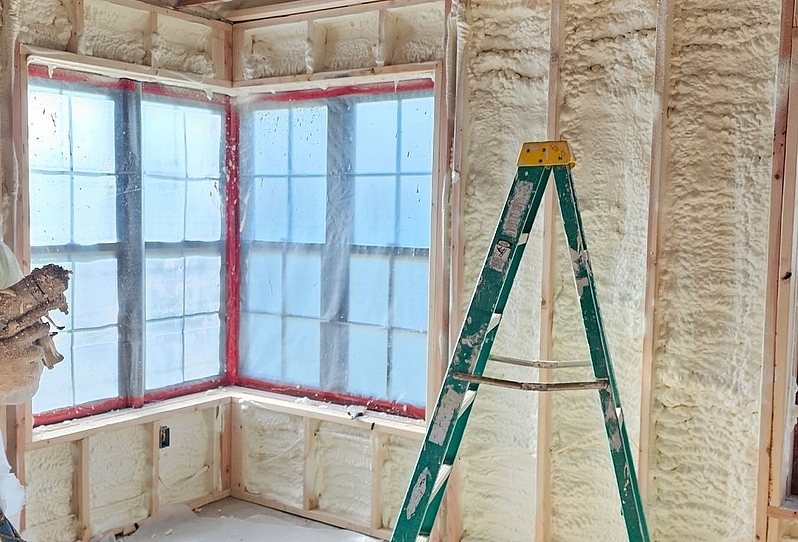
Spray foam insulation is a two-component product that is mixed at the point of application and expands rapidly on contact with the surface being treated. It fills gaps, cracks, and irregular cavities that traditional batt or blown insulation cannot reach, creating a continuous, seamless insulating layer. Once cured, it remains permanently in place without settling, shifting, or degrading.
Sunset Roofing specializes in closed-cell spray foam, the denser and more performance-oriented of the two primary foam types. Understanding the difference between the two types helps homeowners make an informed choice.
Closed-Cell Spray Foam
Closed-cell spray foam is a rigid, high-density material with closed internal cells that do not allow air or moisture to pass through them. This structure gives it a significantly higher R-value per inch than any other common insulation material — approximately R-6 to R-7 per inch, compared to R-3.5 for standard fiberglass batts. It also creates a genuine vapor barrier, preventing moisture from migrating through the building envelope. Closed-cell foam adds measurable structural rigidity to walls and roof assemblies, a meaningful benefit in a snow-load environment like Rochester.
Open-Cell Spray Foam
Open-cell foam is softer, lighter, and less expensive per square foot, with a lower R-value per inch (approximately R-3.5 to R-4). It is an excellent sound absorber and is well-suited to interior wall cavities and areas where moisture vapor permeability is acceptable. However, it is not an effective vapor barrier on its own and should not be used as the primary insulation in attics, crawl spaces, or other areas where moisture control is critical.
In Rochester's cold climate, closed-cell foam is the appropriate specification for most roofing-related applications, particularly attic encapsulation, rim joist insulation, and any area where both thermal performance and moisture resistance are required.
How Spray Foam Connects to Your Roof's Performance
Many homeowners think of insulation and roofing as separate systems, but they are deeply interconnected — and in Rochester's climate, the connection has significant practical consequences.
Ice Dam Prevention
Ice dams are one of the most damaging recurring problems for Rochester roofs, and inadequate attic insulation is the primary cause of most ice dam situations. When heat escapes through an insufficiently insulated attic floor into the attic space, it warms the underside of the roof deck. That heat melts snow on the upper portions of the roof, which runs down to the cold eaves and refreezes. As ice builds up at the eave, it traps water that can back up under shingles and into the structure.
Properly installed spray foam insulation on the underside of the roof deck — what is called an "encapsulated" or "conditioned" attic — eliminates the heat differential that causes ice dams. When the roof deck is kept uniformly cold (because heat no longer escapes through it), snow melts evenly and does not create the dam conditions at the eave. This is one of the most effective and permanent solutions to Rochester's chronic ice dam problem.
If your home has experienced repeated ice dam damage, pairing a new residential roof installation with attic spray foam insulation addresses the cause rather than just the symptom.
Roof Longevity
Roofs that sit over poorly insulated and poorly ventilated attics deteriorate faster. Excessive heat buildup in summer accelerates the drying and brittleness of asphalt shingles. Moisture cycling through the attic promotes rot in roof decking and mold in insulation. Proper attic conditions, supported by appropriate insulation strategy, directly extend the service life of the roofing system above.
Energy Efficiency Throughout the Year
In winter, a well-insulated and air-sealed attic or roof assembly keeps conditioned heat inside the living space where it belongs, reducing the load on your heating system. In summer, a properly insulated roof system limits solar heat gain, keeping attic temperatures lower and reducing air conditioning loads. In Rochester's climate, where both heating and cooling seasons are significant, the annual energy savings from quality insulation are substantial and cumulative.
Where Spray Foam Is Most Effective in Rochester Homes
Spray foam insulation can be applied in multiple locations throughout a home, each addressing specific performance problems:
Attic Roof Deck (Encapsulated Attic)
Applying closed-cell spray foam directly to the underside of the roof deck and the inside of the gable walls creates a "hot roof" assembly where the attic is brought inside the thermal envelope of the home. This approach eliminates ice dam conditions, prevents duct leakage losses in homes with HVAC equipment in the attic, and creates a stable, conditioned storage environment. This is the highest-performance attic insulation strategy available for Rochester homes.
Attic Floor (Traditional Approach)
When the goal is simply to insulate the living space below rather than condition the attic, spray foam applied to the attic floor (above the ceiling of the top floor) provides superior air-sealing performance compared to blown or batt insulation. Foam seals around every penetration — light fixtures, plumbing stacks, wiring — eliminating the air bypasses that make traditional attic insulation less effective than its R-value rating suggests.
Rim Joists
The rim joist area — where the floor framing meets the foundation walls — is one of the most significant sources of heat loss and cold air infiltration in most Rochester homes. It is also difficult to insulate effectively with cut-and-fit batt insulation. Spray foam fills this cavity completely, air-seals simultaneously, and provides the vapor barrier needed to prevent moisture problems in this typically cold and damp zone.
Crawl Spaces
Uninsulated or inadequately insulated crawl spaces are a significant source of energy loss and moisture problems. Spray foam applied to the crawl space walls and rim joists creates a conditioned crawl space that dramatically reduces floor coldness above, prevents pipe freezing in winter, and controls moisture that can otherwise migrate into the living space and cause mold or structural damage.
Basement Walls
In Rochester's cold winters, basement walls represent a substantial thermal boundary between the heated living space and the surrounding ground, which maintains a temperature close to the average annual outdoor temperature. Closed-cell spray foam applied to basement walls provides both insulation and a vapor barrier in a single application, preventing the condensation and moisture issues that plague traditional fiberglass insulation in below-grade applications.
The Financial Case for Spray Foam in Rochester
Spray foam insulation carries a higher upfront cost than fiberglass batts or blown cellulose insulation, and it is important to evaluate this investment with a realistic understanding of the returns.
Energy savings are the most direct financial benefit. Rochester homeowners with poorly insulated homes can reduce heating and cooling costs by 15 to 30 percent or more after a comprehensive air-sealing and insulation upgrade. Over a 10- to 15-year period, the accumulated savings typically exceed the installation cost, and the comfort and moisture control benefits are delivered from day one.
Avoided repair costs are the second financial consideration. Ice dam damage, roof deck rot, mold remediation, and structural damage from moisture are all costs that proper insulation helps prevent. These avoided costs are harder to calculate precisely but are very real for Rochester homeowners who have experienced them.
Property value is the third factor. Energy-efficient homes command higher sale prices and sell faster in today's market, where buyers are increasingly attuned to energy costs and indoor comfort. Documentation of spray foam installation is a selling point that experienced real estate professionals can leverage effectively.
Financing options are available for homeowners who want to make this investment without paying the full cost upfront. Sunset Roofing offers flexible financing that makes spray foam insulation accessible regardless of where you are in your budgeting cycle.
Spray Foam for Commercial Buildings in Rochester
Commercial buildings benefit from spray foam insulation in similar ways to residential properties, often at greater scale and with proportionally larger energy savings. Large commercial roof assemblies — particularly flat roofing systems — benefit enormously from the air-sealing and thermal performance of spray foam installed as part of a roof system overhaul.
For warehouses, manufacturing facilities, and large commercial spaces where controlling temperature and humidity is critical to operations, spray foam insulation is one of the highest-impact investments available. Sunset Roofing's commercial spray foam insulation services are tailored to each facility's specific conditions and performance goals.
Why Choose Sunset Roofing for Spray Foam Insulation
Spray foam insulation requires more technical precision in application than most other insulation products. The two components must be mixed at the correct ratio and applied at the correct temperature and thickness to achieve rated performance. Improperly installed spray foam can have lower-than-rated R-values, adhesion problems, or off-gassing issues. Working with an experienced contractor who uses professional-grade equipment and quality products is not optional — it is essential to getting the performance you are paying for.
Sunset Roofing's team is trained in spray foam application and has the equipment and experience to deliver consistent, high-quality results. Because we offer both roofing services and spray foam insulation, we can address your roof and attic as a connected system rather than in isolated pieces — which is how these systems actually work.
To learn more or to schedule a consultation, request a free spray foam insulation estimate from Sunset Roofing, or call us at 585-538-6086. We serve residential and commercial customers throughout Rochester and Western New York.
‹ Back
Recent Posts
-

Why Fall Is the Best Season for a Roof Replacement in Rochester
September 17, 2026
-
Gutter Guards Before Leaf Season: Are They Worth It in Rochester?
September 10, 2026
-
Fall Roof Maintenance Checklist for Rochester, NY Homeowners
September 3, 2026
-
-
Summer Maintenance for Commercial Flat Roofs in Rochester, NY
August 21, 2026
