

Blog
When homeowners picture a roof, they picture shingles. What almost nobody pictures is the band of trim and metal that runs around the perimeter, the fascia, the soffit, and the drip edge, and yet these unglamorous components do an enormous amount of the work of keeping water out of a house.
They also happen to be the first things to fail. The edge of a roof is where water concentrates, where ice builds in winter, where wind gets underneath, and where squirrels and birds look for a way in. A roof can have perfectly sound shingles across the field and still leak, rot, and shed heat because the perimeter details were neglected or installed poorly.
This article explains what fascia, soffit, and drip edge actually do, how they deteriorate in Western New York, and why paying attention to them during a re-roof matters more than most homeowners realize.
What These Three Components Actually Are
They are easy to confuse because they all live in the same few inches of the roofline, so it helps to separate them.
Fascia is the vertical board that runs along the lower edge of the roof, capping the ends of the rafters. It is what your gutters are fastened to, and it is the trim you actually see when you look at the edge of the roof from the ground.
Soffit is the horizontal underside of the roof overhang, the panel you see when you stand beneath the eave and look up. In a properly built house it is not solid, it is vented, and those vents are the intake side of the attic ventilation system.
Drip edge is a piece of angled metal flashing installed along the roof edges beneath the shingles. It extends past the fascia and directs water off the roof and into the gutter instead of letting it run backward along the underside of the shingles.
Why Each One Matters
Individually these seem like trim details. Together they control water and air at the most vulnerable part of the roof.
Drip edge is the smallest component and arguably the most important. Without it, water leaving the roof clings to the underside of the shingle and runs back onto the fascia and behind the gutter, a process called capillary action. Over years this soaks and rots the fascia, the sheathing edge, and eventually the rafter tails, all from a defect you cannot see. Drip edge is now required by code in most applications for exactly this reason, but plenty of older Rochester homes were built or re-roofed without it.
Fascia carries the gutters, and gutters full of snow and ice are heavy. Rotted fascia cannot hold a gutter spike or hanger, which is why sagging and pulling gutters are so often a fascia problem rather than a gutter problem.
Soffit vents feed the entire attic ventilation system. Air is supposed to enter low at the soffit and exit high at the ridge, and that continuous flow is what keeps the roof deck cold in winter and prevents the uneven melting that causes ice dams. Blocked or absent soffit venting undermines the whole system, no matter how good the ridge vent is.
How They Fail in Western New York
Our climate is unusually hard on the roof perimeter, and the failures follow a predictable pattern.
Ice damming. When ice builds at the eaves, meltwater backs up behind it and sits directly on the most vulnerable part of the assembly. Repeated winters of this saturate the fascia and the edge of the decking.
Gutter overflow. A gutter clogged with leaves sends water straight down the face of the fascia through every rain. Combined with missing drip edge, this is the single most common cause of rotted fascia we find.
Insulation blocking soffit vents. When attic insulation is added without baffles, it gets pushed into the eaves and buries the soffit vents. The homeowner improves insulation and unknowingly disables ventilation, which is a common and counterproductive combination.
Animals. Soft, rotted fascia and loose soffit panels are an open invitation to squirrels, birds, and bats, which then enlarge the opening and nest in the attic.
If your gutters sag, your fascia looks dark or soft, or you have had ice dams, the roofline is worth a look before winter. Request a free estimate and we will assess the whole perimeter, not just the shingles.
Why a Re-Roof Is the Time to Address Them
The perimeter is accessible during a tear-off in a way it never is otherwise, which makes a re-roof the natural and most economical time to correct it.
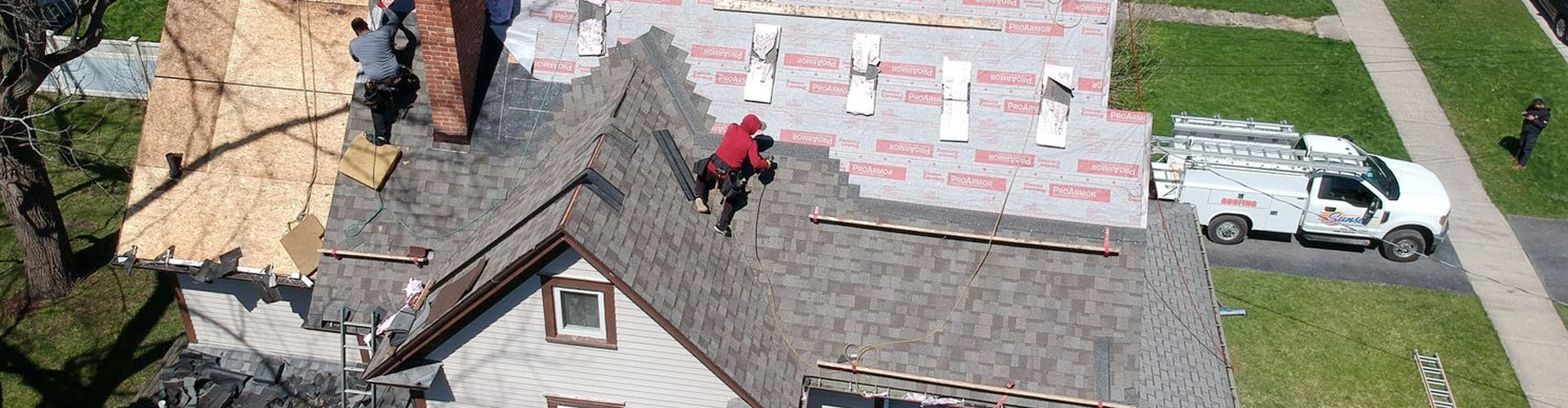
With the old shingles off, the condition of the decking edge, the fascia, and the drip edge is fully visible. New drip edge can be installed properly, integrated with the underlayment and ice and water shield in the correct order. Rotted fascia can be replaced while the gutters are already down. Soffit venting can be opened up and baffles installed so the new insulation cannot block airflow again.
Doing this work later, as a separate project, means paying again to remove gutters and disturb the roof edge. Skipping it entirely means installing a new roof over a perimeter that is already compromised, which is how a new roof develops old problems.
Signs Your Roofline Needs Attention
Most of these are visible from the ground with a few minutes of looking.
Look for gutters that sag, pull away from the house, or have visible gaps behind them. Look at the fascia board itself for peeling paint, dark staining, soft or crumbling spots, or sections that look swollen. Look up under the eaves for soffit panels that are stained, sagging, missing, or that have obvious gaps and holes. From inside, a lack of daylight or airflow at the eaves of the attic is a sign that soffit venting is blocked or absent.
Water stains on the exterior wall directly beneath the roof edge are a particularly clear signal, since that pattern usually means water is coming off the roof behind the gutter rather than into it.
Get the Whole Roofline Right with Sunset Roofing
For more than 35 years, Sunset Roofing has re-roofed homes across Rochester and Western New York, and we treat the perimeter as part of the roof rather than as trim. Every project includes proper drip edge, an honest assessment of fascia condition, and attention to whether the soffit venting is actually doing its job, because a roof that fails at the edge fails no matter how good the shingles are.
If your gutters are sagging, your fascia is soft, or you simply want to know whether your roofline is in good shape before winter, we are glad to take a look. Request a free estimate, contact our team, or call us directly at 585-538-6086. The details at the edge of your roof are small, inexpensive to get right during a re-roof, and expensive to ignore.
‹ Back
Recent Posts
-
-
-
-
Why Fall Is the Best Season for a Roof Replacement in Rochester
September 17, 2026
-
Gutter Guards Before Leaf Season: Are They Worth It in Rochester?
September 10, 2026
