
Blog
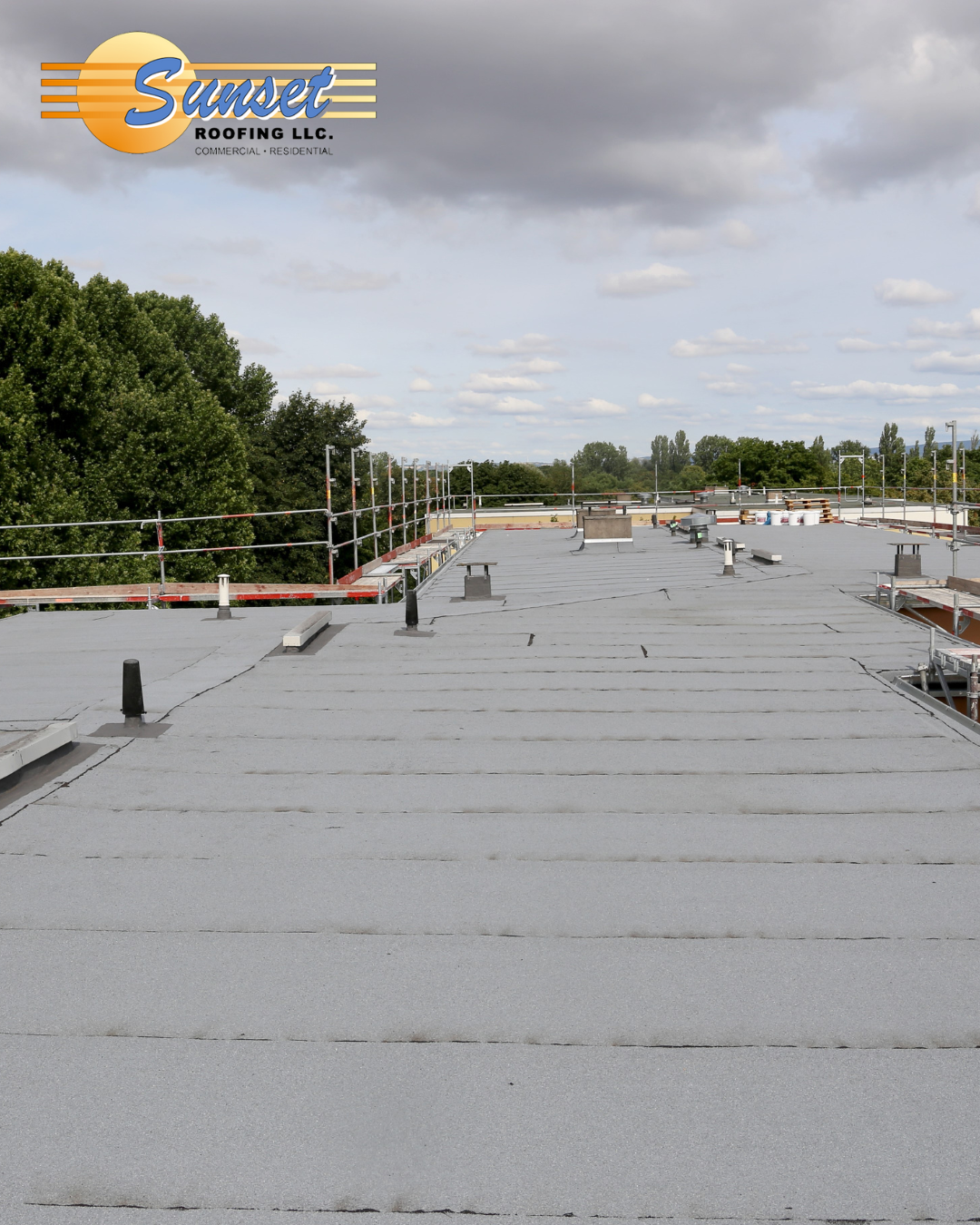
Flat and low slope commercial roofs have one defining characteristic that shapes everything about how they behave in a Rochester winter: they do not shed. Whatever lands on them stays there until it melts or is removed. For four or five months a year, that means a commercial roof in Western New York is carrying a load and managing standing water in conditions where drainage is unreliable.
Most winter roof failures on commercial buildings are not dramatic. They are slow leaks that show up as ceiling tile stains in a corner of a warehouse, or a drain that backed up during a thaw and put water across a stockroom floor. They are also, almost without exception, preventable with attention paid before the weather turns.
This article covers what winter does to a commercial flat roof in our climate, what building owners and facility managers should be watching, and what to do about it.
Snow Load on a Roof That Cannot Shed
A pitched residential roof sheds most of what falls on it. A flat roof holds all of it, which changes the calculation considerably.
The weight itself is usually within design capacity, since commercial buildings in this region are engineered for our snow loads. The complications come from distribution and from water. Wind drifts snow into deep banks against parapet walls, rooftop units, and any change in roof height, concentrating load in specific areas rather than spreading it. And rain falling on an existing snowpack is absorbed and held rather than drained, which can increase the load substantially in hours.
Drifting deserves particular attention because it is predictable. If a building has a lower roof section adjacent to a taller wall, snow will pile there every winter in the same place, and that is the area worth checking after every significant storm.
Drainage Is the Whole Problem
If there is one thing to take away about commercial roofs in winter, it is that everything comes back to drainage.
A flat roof is not actually flat. It is built with a slight slope toward drains, scuppers, or internal leaders, and the entire system depends on water reaching those points and leaving. In winter, three things interfere with that.
Drains freeze. A drain that is holding debris and standing water going into a cold snap becomes a plug of ice, and it stays a plug all winter. Meltwater then has nowhere to go.
Debris accumulates. Leaves, wrappers, and sediment migrate toward drains, which is exactly where they cause the most harm. A drain strainer that is clogged in November is a guaranteed problem in January.
Ponding freezes and expands. Any area where water already stands after a rain is an area where ice will form, and ice expands. That expansion works at seams, flashings, and membrane laps, opening them slightly each cycle.
The consequence is water backing up across the roof surface, sitting against seams and penetrations that were designed to shed water rather than be submerged, and eventually finding a way through.
What Fails, and Where
Winter damage on a commercial roof concentrates in predictable places, and they are the places worth inspecting.
Seams and laps. The membrane field is rarely the failure point. The joints are. Freeze and thaw cycling combined with the contraction of cold materials puts stress directly on seams, and any lap that was marginal to begin with will open.
Flashings and penetrations. Every rooftop unit, vent, pipe, curb, and skylight is a hole in the roof that has been sealed. These details take the most abuse from ice and from standing water, and they account for the large majority of leaks.
Parapet walls and edges. The perimeter takes drifting, ice buildup, and wind uplift all at once. Coping joints and edge metal are common entry points.
Membrane splits. Cold makes roofing membranes contract and become less flexible. An older membrane that has lost its plasticizers can split under thermal stress, particularly at changes in plane.
If you manage a commercial building and want the roof assessed before the weather turns, contact our team and we will get out and look at it.
What to Do Before the Weather Turns
Late fall preparation on a commercial roof is short, cheap, and disproportionately valuable.
Clear every drain, scupper, and gutter completely, and confirm they actually flow rather than assuming they do. Remove debris from the roof surface generally, particularly anything that will migrate toward a drain. Walk the perimeter and check coping, edge metal, and parapet flashings. Inspect the flashing at every rooftop penetration and unit curb. Look for any area of ponding and note it, because that is where ice will form. Repair open seams and failed sealant now, while materials are still warm enough to bond properly.
That last point matters more than it sounds. Many roofing materials and adhesives have minimum application temperatures, and repairs that are simple in October become difficult or impossible in January.
Snow Removal on a Commercial Roof
Sometimes snow does need to come off, and this is an area where well intentioned action causes serious damage.
Removal is warranted when accumulation is heavy and rain is coming, when drifting has created a concentrated load, when the building has known structural limitations, or when drains are buried and meltwater has no path. It should not be routine.
When it is done, it needs to be done by people who understand roofing. Metal shovels, ice chippers, and heavy equipment will cut a membrane, and a cut membrane in January is a difficult and expensive repair. Crews should leave a thin layer of snow rather than scraping to the surface, work with plastic tools, avoid piling removed snow in concentrated areas which simply relocates the load problem, and take care not to damage rooftop units. Clearing the area around the drains is often the single most valuable thing that can be done.
Commercial Roofing Through the Winter with Sunset Roofing
For more than 35 years, Sunset Roofing has maintained and repaired commercial roofs across Rochester and Western New York, from warehouses and storefronts to agricultural and industrial buildings. We know what our winters do to a low slope roof, and we would rather clear your drains and close up your seams in November than chase a leak across your ceiling in February.
If you are responsible for a commercial building and the roof has not been looked at this year, now is the time. Request a free estimate, contact our team, or call us directly at 585-538-6086. On a flat roof, winter finds every weakness, and the ones you address now are the ones that never become a problem.
‹ Back
Recent Posts
-
Commercial Flat Roofs in Winter: Snow, Ice, and Drainage in Rochester
November 19, 2026
-

Winterizing Your Gutters Before Rochester's First Hard Freeze
November 12, 2026
-

How Much Snow Can Your Rochester Roof Actually Hold?
November 5, 2026
-

Choosing Shingle Colors for Your Rochester Home
October 29, 2026
-